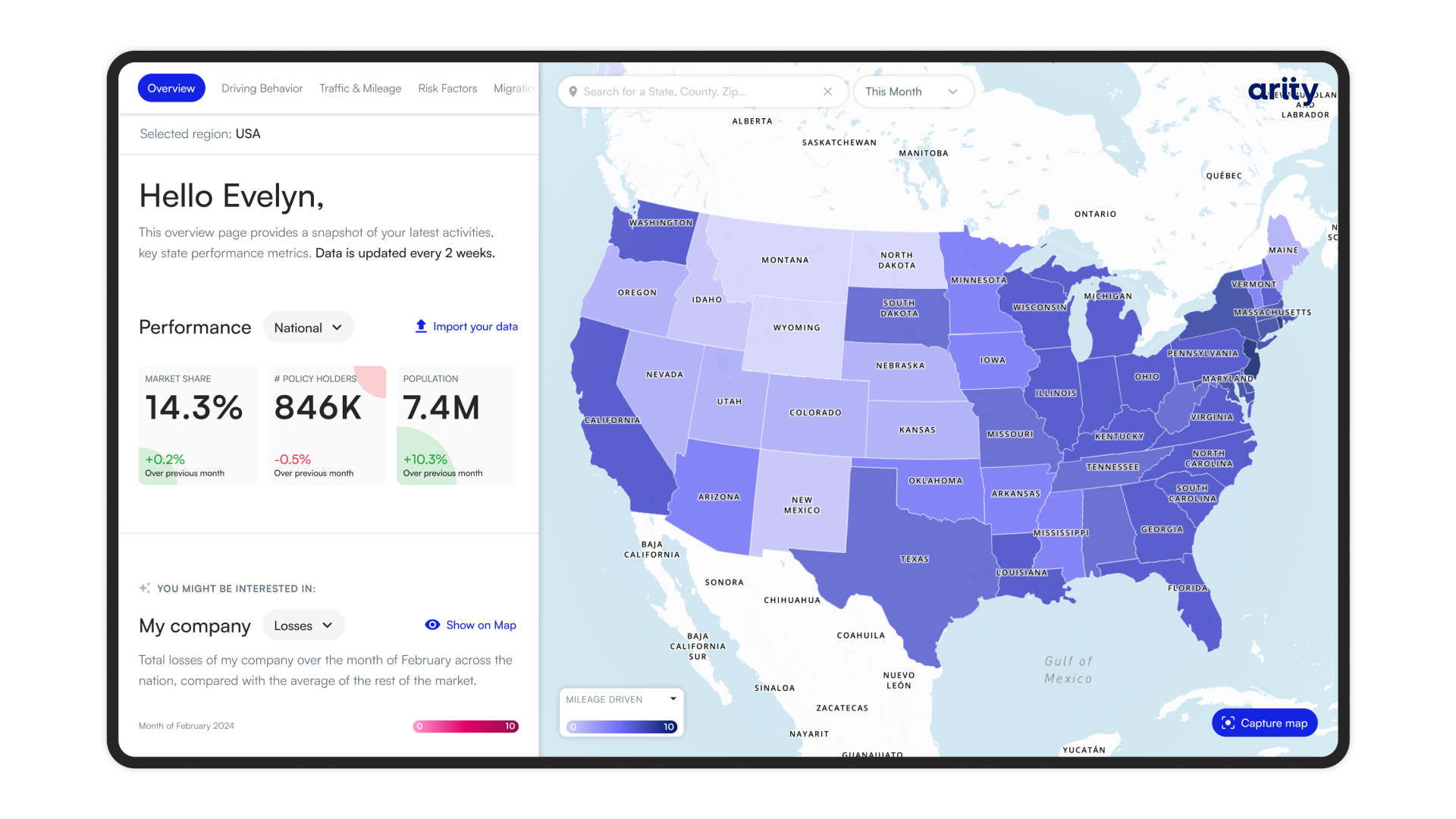
A future product vision for Arity's mobility intelligence platform — moving from raw data to curated insights that inspire current and potential customers.
Arity sits on one of the richest mobility datasets in the world — over 1.5 billion driving miles ingested daily. The challenge was to envision a state-of-the-art product that transforms this raw data into curated insights, serving diverse industries beyond insurance: retailers, automotive OEMs, and infrastructure solution providers.
Over six weeks, Arity and CLEVER°FRANKE collaborated on a concept vision for a future Arity product in Mobility Intelligence. This first iteration was intended to provide input and inspiration for the larger product roadmap — not a roadmap itself, but a north star.
Create a state-of-the-art product that:
The vision addressed three distinct industry use cases to demonstrate the platform's versatility:
As a retailer, find the best location for a new site or store. Trip-count data is transformed into actionable indicators — visitors and potential visitors — to rank candidate locations by commercial viability.
As an OEM, understand how autonomous driving features impact risk. Mobility data provides context for how vehicles are used in the real world, supporting safety analysis and product development.
As a solution provider, understand movement patterns (volume and speed) to support informed road-use decisions. Deep filtering and temporal analysis enable thorough expert investigation.
Four design principles guided development of the vision:
The product allows users to move between guided narratives and exploratory analysis in one cohesive experience, organized into three layers tied to user needs.
Highly guided data navigation with personalized recommendations. An AI assistant analyzes datasets to support informed business decisions — transforming trip data into actionable visitor-based indicators. Users can include or exclude data layers (commercial activity, traffic volume, competitors, demographics) for both expert and non-expert workflows.
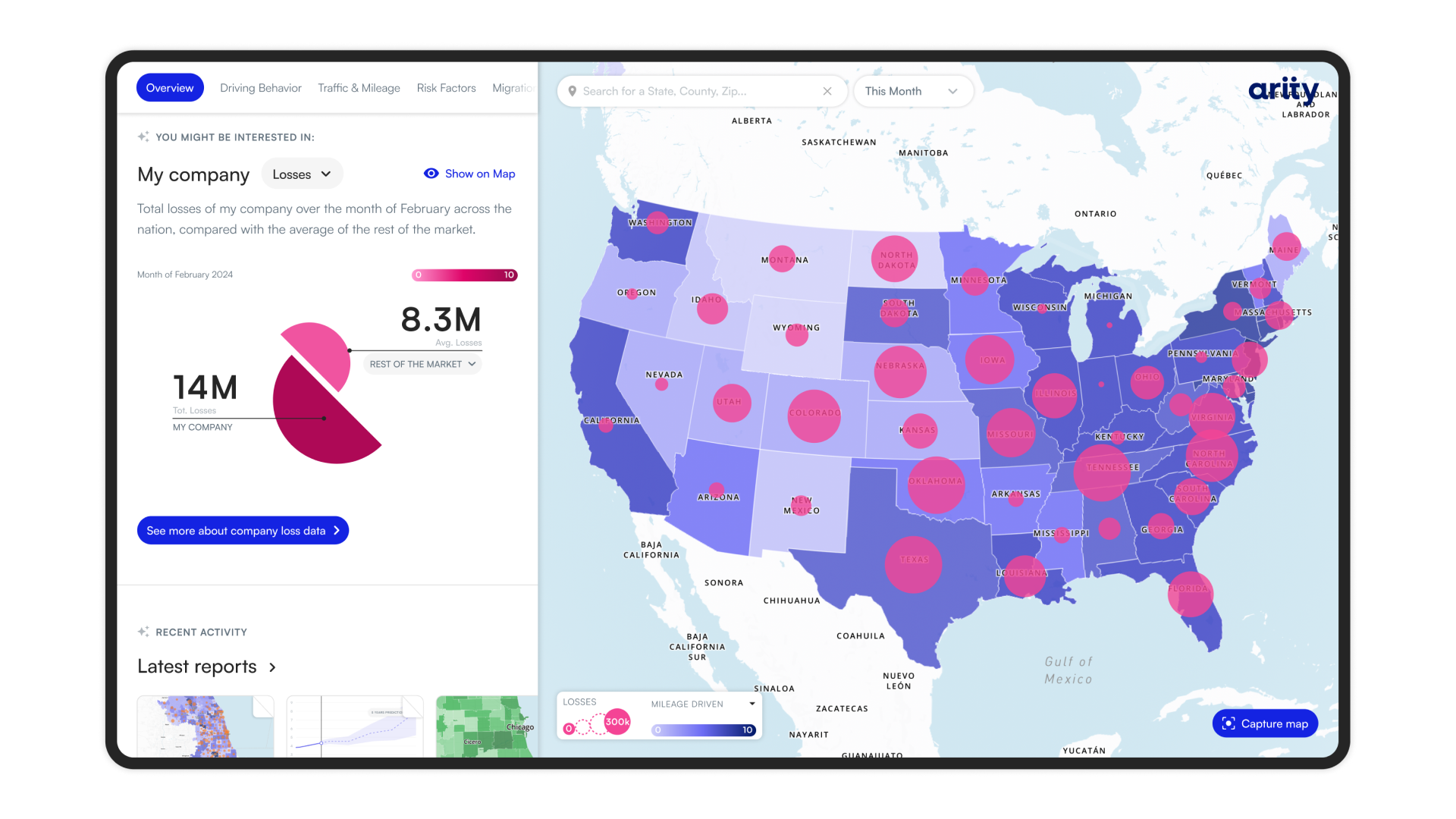
A semi-guided journey with short insights and narrative structure. Contextual information beside the map helps users handle complex datasets. Insights adapt dynamically based on map extent and selected data — combining Arity mobility data with open data (meteorological, census) to increase explanatory power. Findings can be exported to structured reports.
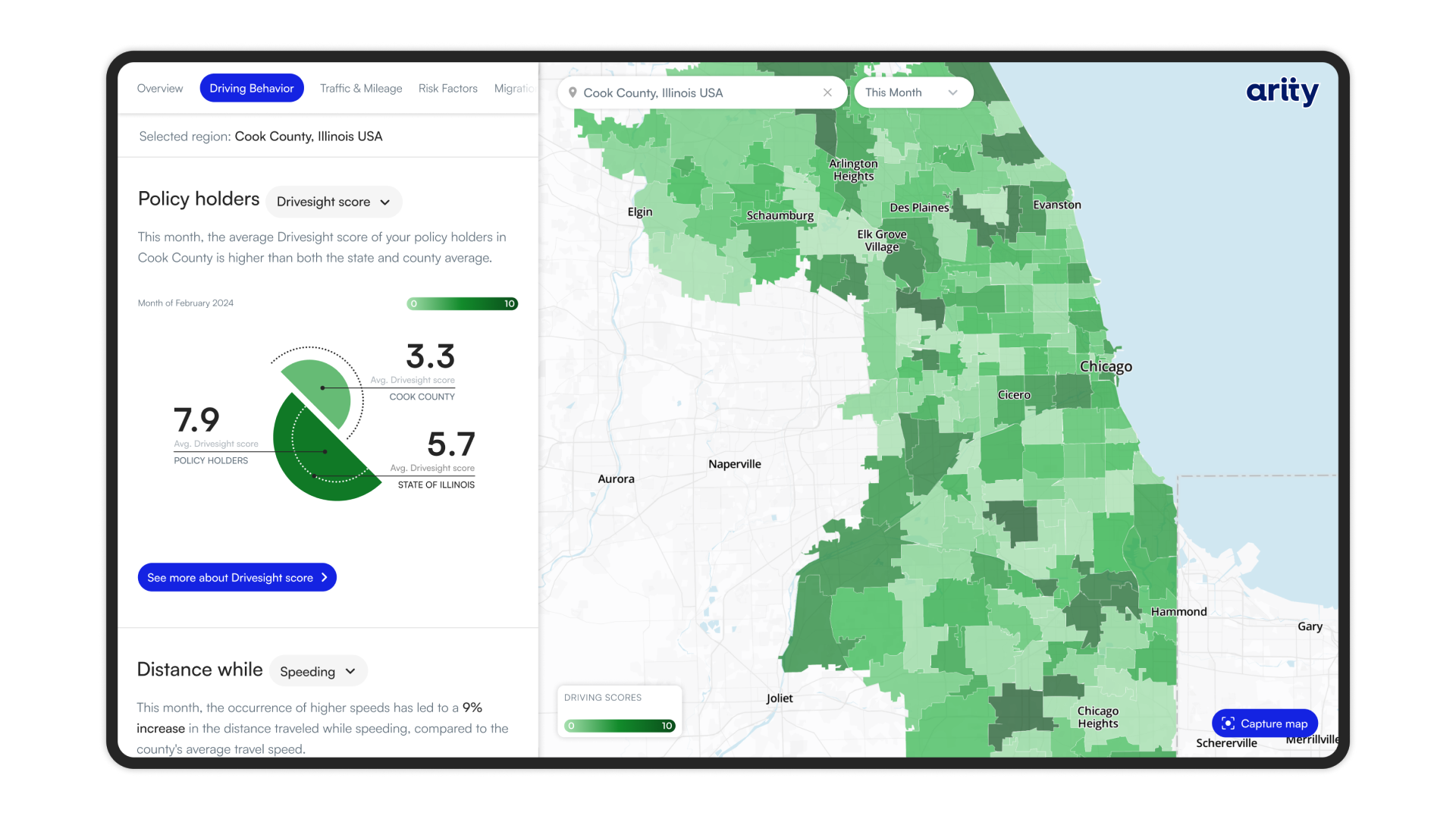
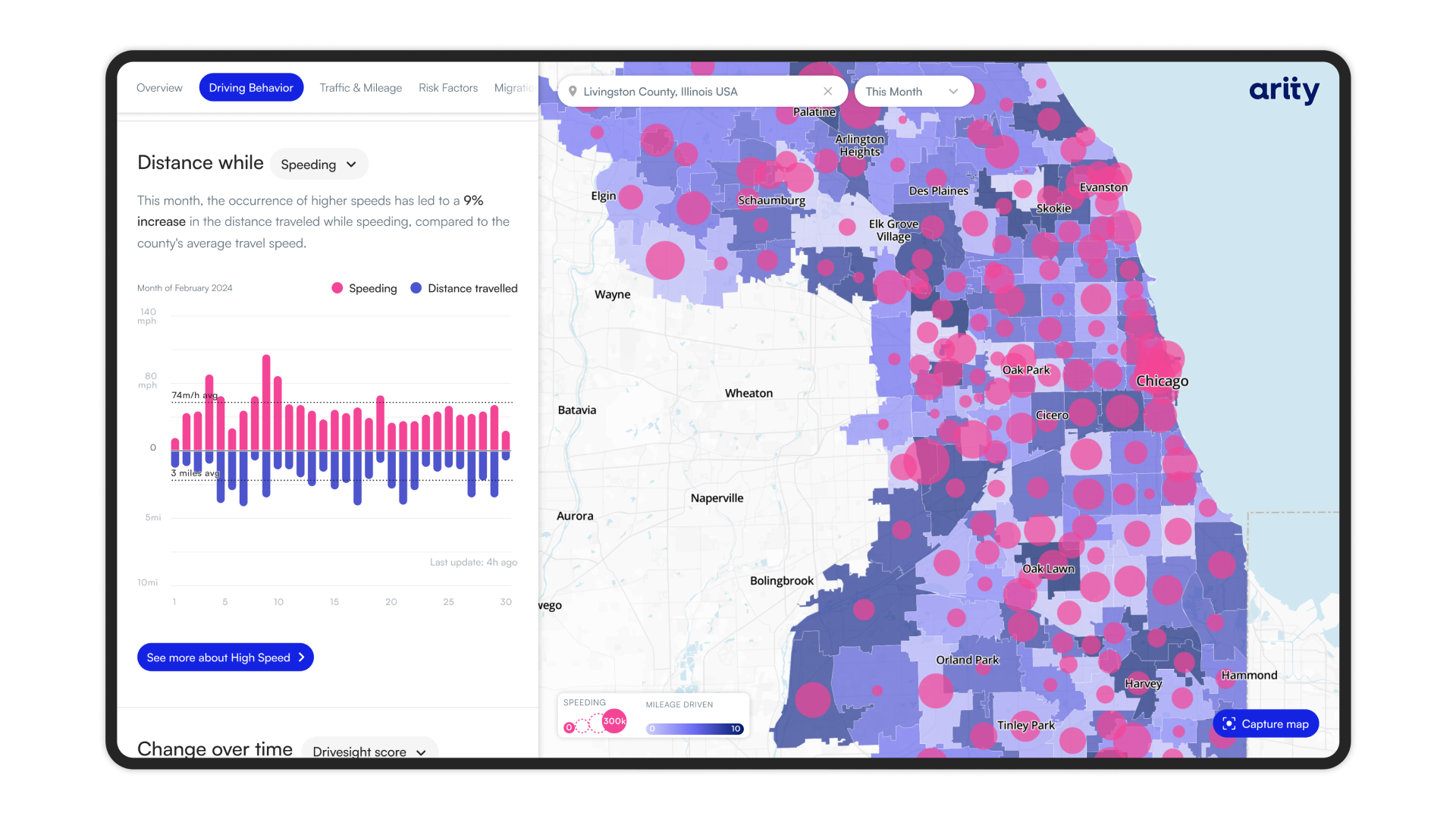
Free-search mode for flexible analysis and scenario testing. Users can experiment with filters and layers without a fixed narrative. Supports deep filtering and indicator analysis over time, with street-segment-level granularity. Privacy guardrails prompt users to broaden filters when selections are too narrow. The tool transforms map data into charts and graphs for alternate analytical views.
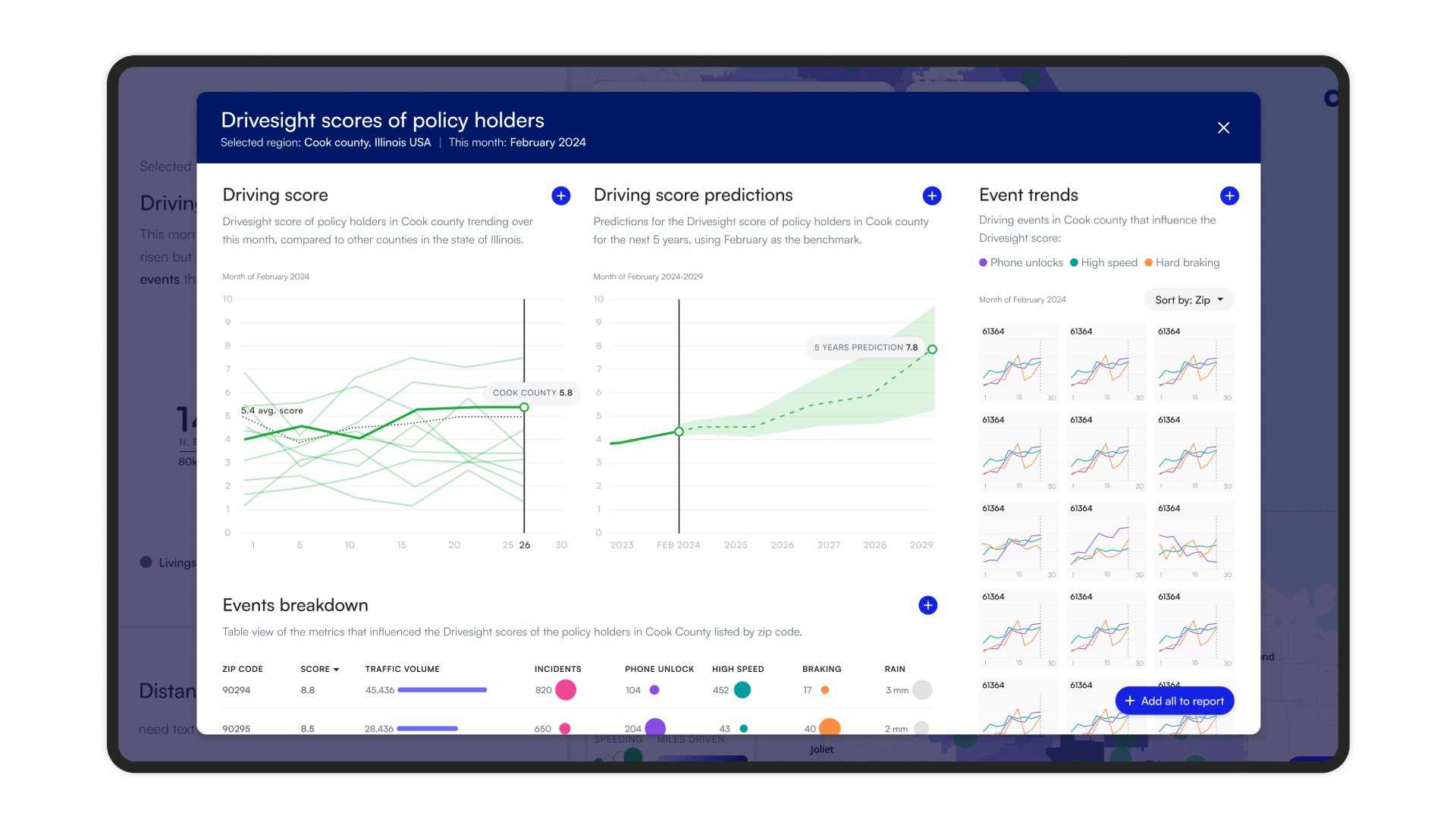
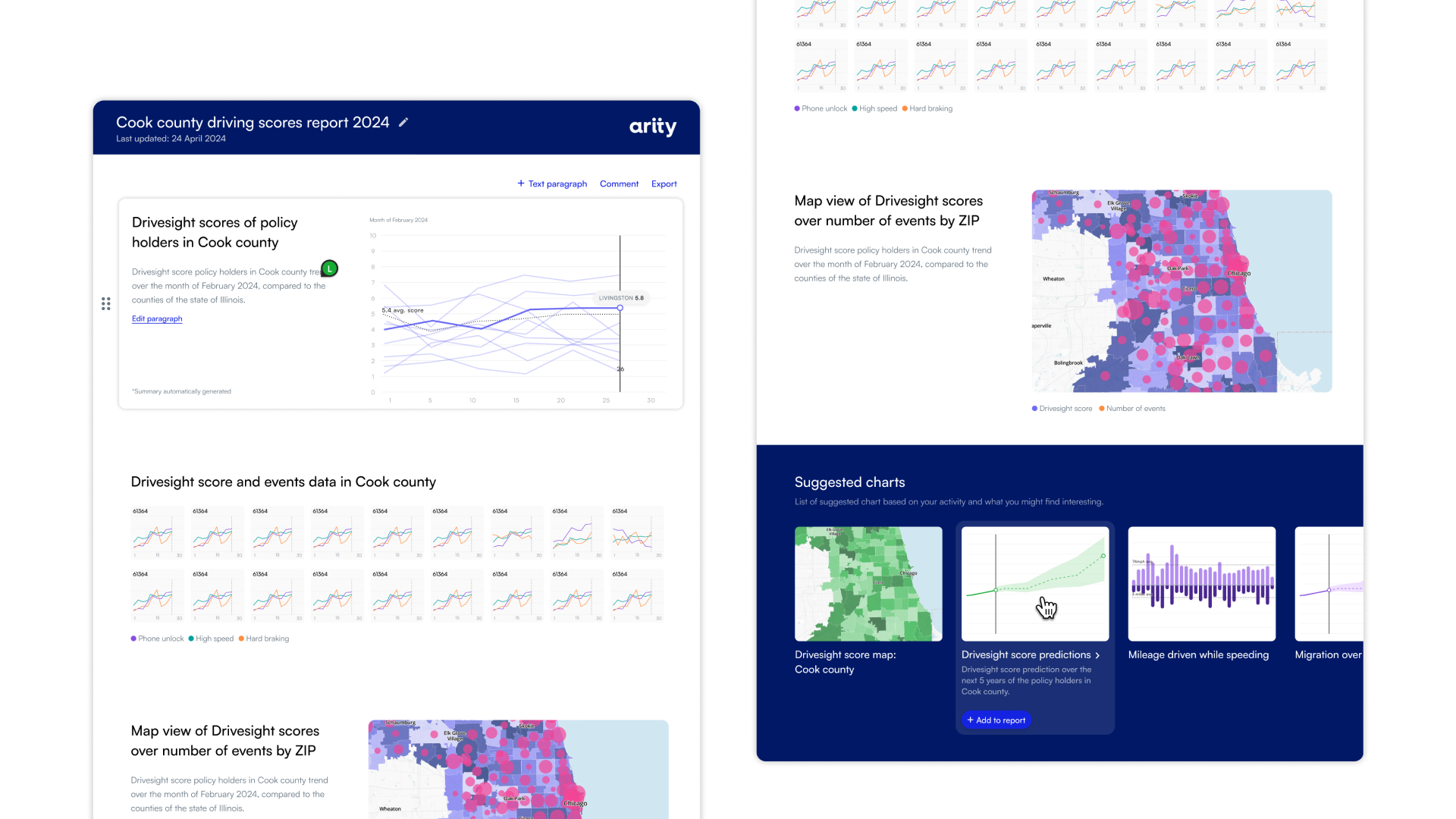
Visualizations were custom-designed as a first step into Arity's updated brand identity. The dot-dash system serves as the foundation for maps, charts, and the broader interface. Next steps defined color palette rules, typography, component libraries, iconography standards, interaction guidelines, and responsive design rules.
The Mobility Intelligence vision provided a compelling north star for Arity's product roadmap — demonstrating how the platform could serve industries far beyond insurance. The three-layer approach (Making Decisions, Finding Insights, Exploring Data) created a scalable framework that balances guided simplicity with expert-grade depth, all while keeping privacy at the center of every interaction.
This vision has since informed product strategy and served as the foundation for stakeholder conversations about Arity's expanded market positioning.